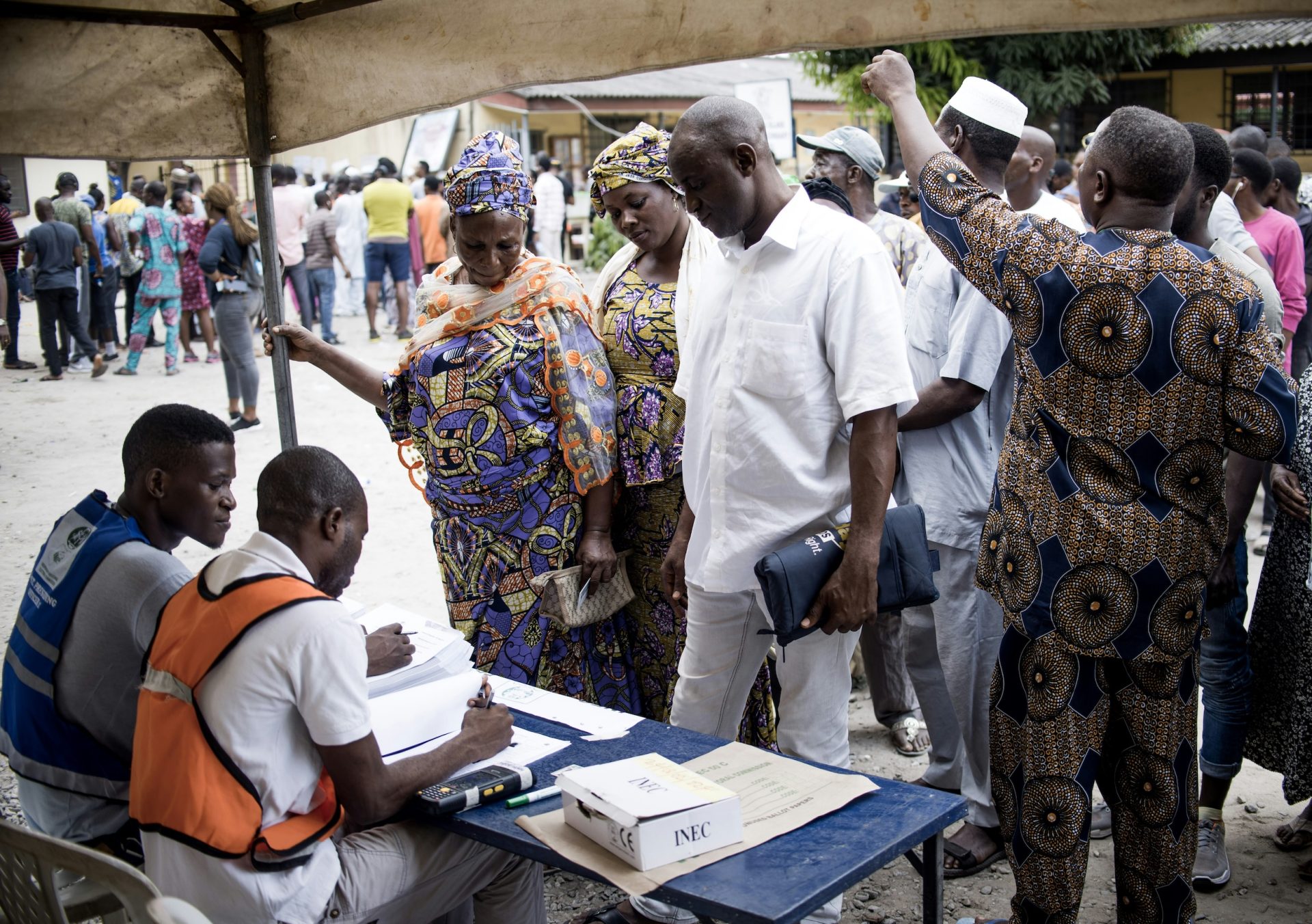
Across the WISH Dividend programme countries, progress on SRHR takes place in complex and sometimes fragile political contexts, with legal constraints and increasingly limited funding. Women and girls continue to face barriers to accessing services, particularly where policies are outdated, domestic financing is insufficient, or issues are politically sensitive.
Parliamentarians shape national laws, approve public budgets, and oversee government performance. Their engagement is therefore essential to advancing sustainable reforms in SRHR. Despite their central role, parliamentarians have not always been engaged in structured or sustained ways on SRHR issues. Engagement has often relied on short-term advocacy efforts, and discussions have not consistently translated into concrete legislative or oversight action. As a result, follow-through has been limited.
WISH Dividend identified an opportunity to strengthen more structured engagement with parliamentarians. By working through formal legislative, oversight, and budget processes, and by building longer-term partnerships, WISH Dividend aimed to anchor SRHR within national governance systems. This approach sought to strengthen accountability, support sustained political commitment and reduce reliance on individual champions or external funding cycles.
“Engagement with parliamentarians is most effective when it aligns with national policy priorities and existing governance processes. This helps position SRHR not as an external agenda, but as part of broader development and accountability efforts.” Julian Nyamupachitu, Regional Monitoring, Evaluation, Research, and Learning Lead, Options
Strategic pathways to engaging parliamentarians
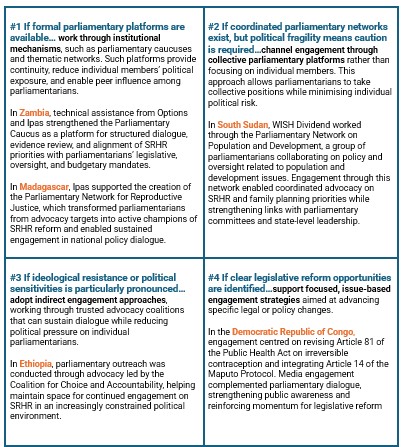
Engaging parliamentarians on SRHR requires deliberate and context-sensitive strategies. Rather than applying a single advocacy model, WISH Dividend partners selected engagement approaches based on political context, institutional maturity, and opportunities for reform. Across countries, four main strategic pathways were used to engage parliamentarians while managing political sensitivity and maximising opportunities for policy influence.
Strengthening engagement in constrained political environments
Engaging parliamentarians on SRHR presented WISH Dividend partners with several structural and contextual challenges. In many settings, SRHR remains politically sensitive, influenced by social norms, ideological resistance, and concerns about public perception. Parliamentarians are also required to balance multiple national priorities, including economic pressures, security concerns, and humanitarian needs, which can limit sustained political attention to SRHR-related reforms.
Working with parliamentarians requires a high level of flexibility and adaptability. With each election, new parliamentary partners and champions may need to be identified and engaged to replace those that leave. One way to prepare for this disruption in relationships is to take the broader political agenda into account when selecting the pool of champions, looking across the political spectrum, to increase the likelihood that some will remain after an election.
Taking a cross-party approach to advocacy also avoids an issue being perceived as being aligned with a single party or political agenda and helps engagement not fall under lobbying, which is prohibited under many donor frameworks. This risk can be avoided further, through framing messaging and requests carefully, ensuring that parliamentarians are not asked to vote in a specific way, but instead are provided with evidence to support informed decision-making.
The challenges of political engagement were compounded by a tightening external funding environment, reinforcing the need for approaches that do not rely on continuous donor-driven advocacy. Short-term or ad hoc engagement proved insufficient to generate lasting political commitment or institutional follow-through. To address these constraints, WISH Dividend partners prioritised engagement strategies rooted in existing parliamentary systems, such as:
- Working through formal platforms such as caucuses, committees, and networks helped reduce political risk and ensured continuity.
- Aligning engagement with routine parliamentary functions, such as legislative review, budget scrutiny, and oversight processes, made SRHR more actionable within governance structures.
- Using credible national data, legal analysis, and practical accountability tools which further supported informed decision-making.
WISH Dividend’s experience underscores the importance of embedding SRHR priorities within parliamentary systems to support continuity, accountability, and adaptability amid political uncertainty and evolving financing conditions.
“Sustainability in constrained funding environments depends on institutionalisation and domestic ownership. Embedding SRHR priorities within parliamentary oversight and budget processes helps maintain political commitment beyond external funding.” Doreen Manda, Country Manager – Zambia, IPPF
From engagement to institutional and legislative change
The differentiated engagement approaches used by WISH Dividend produced tangible institutional and policy shifts across contexts:
- In Zambia, caucus-based institutionalisation strengthened domestic accountability for SRHR financing. Parliamentarians moved beyond declarations of support to formal parliamentary instruments, including motions, committee inquiries, and budget scrutiny mechanisms. The leadership of women parliamentarians proved instrumental in sustaining engagement and normalising SRHR within routine parliamentary deliberations.
- The establishment of the Parliamentary Network for Reproductive Justice in Madagascar institutionalised parliamentary ownership, ensuring sustained engagement beyond project cycles.
- In South Sudan, engagement resulted in explicit SRHR and family planning commitments at state level and ongoing committee-based oversight discussions, embedding SRHR within structured governance processes.
- Coalition-led outreach in Ethiopia, helped preserve political space for continued SRHR dialogue despite growing constraints.
- In the Democratic Republic of Congo, parliamentary dialogue translated into formal legislative progress, culminating in the submission of a draft bill and its scheduling for parliamentary review in March 2026. This marked a transition from policy discussion to formal legislative action
Taken together, these outcomes demonstrate that institutionalised parliamentary engagement can shift SRHR from issue-based advocacy to embedded governance practice, strengthening resilience to political and financing volatility.
The road ahead: securing long-term institutional gains
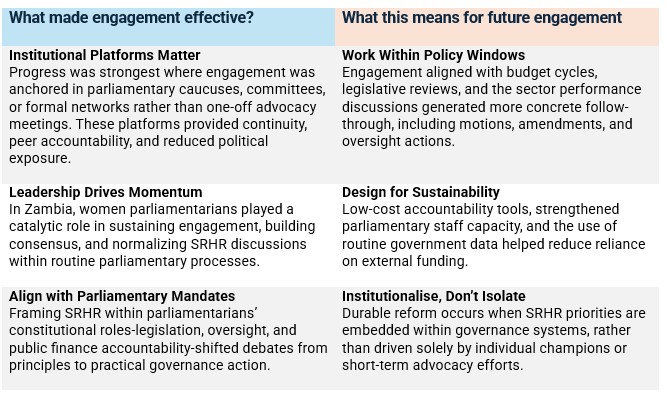
Building on the learning generated through parliamentary engagement under WISH Dividend, future efforts will continue to prioritise approaches that embed SRHR within national legislative, oversight, and accountability systems. Strengthening institutional parliamentary platforms, such as caucuses, networks, and committee mechanisms, will remain central to sustaining engagement beyond individual champions or short-term advocacy initiatives.
WISH Dividend will further integrate parliamentary engagement into policy-tracking and budget-oversight processes, supporting parliamentarians to exercise their constitutional mandates on legislative scrutiny, public finance oversight, and implementation monitoring. Embedding SRHR indicators within routine parliamentary workflows will help translate political commitment into sustained accountability and measurable follow-through.
In response to increasingly constrained external financing environments, WISH Dividend will prioritise sustainability through approaches that are domestically owned, system-embedded, and low marginal cost. This includes strengthening the technical capacity of parliamentary staff and secretariats, promoting the use of routine government data for oversight, and supporting practical accountability tools that can be maintained within existing institutional structures.
Future engagement will also place deliberate emphasis on the leadership of women parliamentarians, whose role in sustaining momentum, building consensus, and reducing political sensitivity around SRHR has proven critical. Finally, WISH Dividend will promote structured cross-country learning to share adaptable engagement models and implementation insights. These approaches are transferable beyond SRHR and can inform policy advocacy in other areas of women’s health, including maternal mental health, where sustained political commitment and accountability are essential.
“Effective parliamentary engagement cannot be built through one-off meetings. It requires consistent dialogue, credible evidence, and practical accountability mechanisms that help translate political commitment into real policy and financing decisions.”Jeremiah Makula, Regional Lead, Options
Lessons from WISH Dividend on effective parliamentary engagement
Further information
Contributors: Tigist Kassa, International Planned Parenthood Federation (Africa Regional Office); Doreen Manda, International Planned Parenthood Federation (Zambia); Fatou Janssen, MSI Reproductive Choices; Julian Nyamupachitu and Jeremiah Makula, Options Consultancy Services Ltd (as part of its phased and managed closure, Options Consultancy Services exited the WISH2 programme at the end of March 2026. Options delivery and technical staff have now been integrated into IPPF and MSI). WISH Dividend Learning Stories are produced by OPM and APHRC, and available in French and English from the WISH Dividend webpage.
WISH Dividend supports women and adolescents, with a focus on the poor and most marginalised and those living in humanitarian contexts, to have greater voice, choice and control over their SRHR. It comprises: WISH2: In West and Central Africa this is led by MSI Reproductive Choices and in East and Southern Africa by the International Planned Parenthood Federation; WISH Policy and Systems: led by Palladium and the Office of National Statistics; WISH Learns: the Evidence & Learning Partner (led by OPM); evidence generation for advocacy on Comprehensive SRHR (led by Guttmacher) and SRHR in emergencies (led by IAWG).